
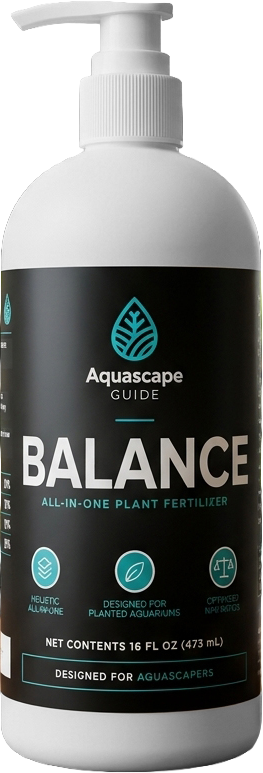
How to dose our all-in-one fertilizer, BALANCE, and BALANCE LITE.


In this article we wanted to go into a little more detail on how to dial in your fertilization table.
Why one dosage doesn't fit every setup
The hard part about developing an all in one fertilizer is that everyone has different setups, so we can't just say "dose two pumps per 10 gallons and you'll be good to go!". We wish fertilization is that simple, but its not. The amount of fertilizer you need depends on much plant mass is in the tank, and how quickly they are going. A high PAR, Co2 injected tank full of plants is going to grow MUCH quicker than a low PAR, non Co2 injected tank. But luckily, this doesn't matter with our kit. And here is why...
Focus on your Nitrates
The amazing thing about BALANCE is that it doesn't matter what kind of setup you have, all you need to do is focus on your nitrates. Let give you two scenarios to better explain what your target is:
Scenario 1 (Perfect scenario):
In a perfect world, you'd have zero ppms of nitrates in your tank. We would dose enough BALANCE throughout the week to increase and sustain the nitrates in your tank by 5-10 ppm. As stated on the bottle, you'll want to start at the recommended dosage of:
BALANCE - High PAR (around 120), Co2 injected - 5 mls or two pumps, 2-3 times a week.
BALANCE LITE - Low PAR (around 60), non Co2 injected - 5 mls or two pumps, 2-3 times a week.
But again, this is a starting point. If by the end of the week you are still at zero nitrates. This means you need to increase the dosage a little. Start by adding a third pump to your fertilization remine, or add an additional day, so dosing 4 times a week. If by the end of the week your nitrates are through the roof, at 20+ppm, you know you are dosing too much and need to cut back on the dosage. We use your nitrates as a float point and try to keep the boosted by 10ppm.
Scenario 2 (Real world application):
In a real world scenario we have fish in our tank and they produce nitrates throughout the week. The hard part no matter what fertilizer you are using, you need to be able to differentiate between the nitrates created by your fish (through the nitrogen cycle), and the nitrates added by your fertilizer. The nitrates produced by your fish are can be used for fertilization, but they don't have all the other 9 macros and micros, so they are incomplete. However, the nitrates added by our fertilizer are set in a ratio which include all the other macros and micros needed for healthy plant growth, which we know is needed due to Liebigs Law Of the Minimum.
So grab an API nitrate test kit to find out what your baseline nitrate reading is for what fish are producing each week. For example sake we'll say that our tank has 10ppm from fish waste. From there we will want to add enough fertilizer to boost your nitrates up by 5-10ppm. This means that you'll need to add enough fertilizer throughout the week to bring you nitrates up from 10ppm (from your fish) to 15-20ppm (with the addition of our fertilizer), and keep it there.
Troubleshooting
Don't drive yourself too crazy with testing your nitrates, as this is going to be a float point. As long as you're hovering around your target nitrate reading, your plants should be happy.

Signs you are too lean
We would suggest running a little too lean, than too rich. Here are a list of signs that you may be running too lean.
Signs of deficiency
Pin holes
Deterioration of leaves
Yellowing of leaves
GSA (green spot algae)
Signs you are too rich
However on the flip side, these are signs that you might be running too rich
GDA (green dust algae)
From Training Wheels to Total Mastery
Think of ASG BALANCE as the ultimate training wheels for your planted tank journey. By running Balance, you learn the foundational "dance" of the hobby—watching how your plants consume nutrients, understanding your tank's bio-load, and mastering the concept of nitrates as a floating point rather than a fixed rule.

Once you’ve built your confidence and want to take absolute control of your water column, you can seamlessly graduate to the ASG Fertilizer Kit. Moving up to the kit allows you to purchase raw individual compound refills, completely customize your NPK ratios to your tank’s exact demands, and unlock the deepest level of precision for your aquascape. Master the balance first, then tailor the science!
Final Thoughts
Now that you have your nutrients dialed in, if you need help balancing out any other parts of your tanks, check out Part 1 of our guide. You can also download our free ASG Method Checklist that has all the metrics you can follow to ensure your tank is balanced.


Comments